









Your Best Tool for Abroad & Learning English

Your Best Tool for Abroad & Learning English

  1. [Breaking News] U.S. Diversity Visa Lottery Suspended: What It Means for International Students and Your Future

    Introduction

    New York City and the rest of the nation are currently processing a major shift in U.S. immigration policy.

    On December 18, 2025, the Trump administration announced the immediate suspension of the Diversity Immigrant Visa Program, commonly known as the “Green Card Lottery.” This decision follows a tragic incident at the Ivy League’s Brown University that has sparked a nationwide debate on national security and immigration vetting.

    At NYEA (New York English Academy), we want to ensure our students are informed about how these changes—and current immigration trends—affect your journey in the United States.


    1. The Trigger: The Brown University Shooting

    The decision to pause this long-standing program was a direct response to the shooting on December 13, 2025, at Brown University and near MIT.

    • The Incident: A suspect (a Portuguese national) opened fire on campus, resulting in the tragic death of two students and injuries to several others.

    • The Connection: Investigators discovered that the suspect had entered the United States and obtained his Green Card in 2017 through the Diversity Visa Lottery.

    • The Policy Shift: Citing “serious flaws in national security,” Homeland Security Secretary Kristi Noem, under President Trump’s direction, ordered a “pause” on the program to prevent further risks.


    2. Why the “Lottery System” is Being Targeted

    The administration has long criticized the lottery system, favoring a transition toward a “Merit-Based” immigration model. The recent events have accelerated this policy goal. The primary concerns cited are:

    • Vetting Limitations: Critics of the lottery argue that choosing immigrants at random makes it difficult to conduct the deep-level background checks required for national security.

    • Shift to Skills and Education: The administration aims to prioritize immigrants with specific professional skills, high education levels, and English proficiency rather than relying on a random drawing.


    3. Real Talk: How Long Does a Green Card Take?

    While the lottery is currently on hold, many NYEA students are pursuing permanent residency through other legal channels, such as Family Sponsorship or Employment-Based visas.

    It is important to understand the typical timelines for these “non-lottery” paths in 2025:

    • Marriage/Family Based: 10 to 18 months.

    • Employment-Based (EB-2/EB-3): 2 to 3+ years.


    4. Critical Advice: Maintaining Your F-1 Status During the Process

    If you are an F-1 student currently applying for an Adjustment of Status (I-485), the recent news serves as a vital reminder: Do not stop maintaining your F-1 student status.

    Why Your F-1 Status is Your “Safety Net”

    Even after you file your Green Card application, you are legally allowed to remain in the U.S. while it is “pending.” However, if your application is denied for any reason—and you have already stopped attending school—you will lose your legal right to stay in the U.S. immediately.

    By maintaining your F-1 status at NYEA, you ensure:

    1. A Backup Plan: If your Green Card is denied, you remain a legal student and can stay to complete your studies or apply for another visa.

    2. A Clean Record: Maintaining status shows U.S. Citizenship and Immigration Services (USCIS) that you are a law-abiding resident who follows all visa regulations.

    3. Active SEVIS Record: Keeping your SEVIS record active is the best way to avoid “unlawful presence” issues.


    A Message from NYEA

    The U.S. immigration landscape is changing, shifting toward stricter vetting and higher standards for skills and education. In this environment, your education is your greatest asset. By staying in school, improving your English, and following all visa rules, you are building a profile that is “vetted” and “merit-based”—exactly what the U.S. government is looking for in future residents.

    Stay focused on your goals, keep your status secure, and remember that NYEA is here to support your American dream every step of the way.
  2. Are you currently in the U.S. and looking to change your status to F-1 student? While a Change of Status (COS) from a B-1/B-2 or J-1 visa might seem like a straightforward way to transition without leaving the country, it carries significant limitations, especially concerning international travel.

    This comprehensive guide delves into the specifics of the COS process, the “Domestic-Only” nature of F-1 status obtained this way, the strict rules regarding departure from the U.S., and important exceptions like Automatic Visa Revalidation (AVR).


    1. What is Change of Status (COS)?

    Change of Status (COS) is a legal process allowing an eligible non-immigrant to switch from one visa classification (e.g., J-1 to F-1, B-2 to F-1) to another while remaining physically present within the United States.

    • Administered by: U.S. Citizenship and Immigration Services (USCIS).

    • Outcome: Upon approval, you receive an I-797 Approval Notice. This document grants you legal “Status” to stay in the U.S. in your new classification, but it does not provide a physical “Visa” sticker in your passport.


    2. The “Domestic-Only” Nature of COS Approval

    It’s a critical distinction: an F-1 status obtained via COS is NOT the same as having an F-1 visa stamp.

    • SEVIS Status: Your SEVIS record will become “Active” on the effective date of your F-1 status.

    • No Visa Stamp: Your passport will lack the actual F-1 visa foil required for entry.

    • Limited Scope: An approved COS is exclusively valid for maintaining your legal status within the U.S. It does not confer any rights or documents for entering the U.S.


    ⚠️ The Travel Trap: What Happens if You Leave the U.S.?

    If you obtain F-1 status through COS and subsequently depart the United States, your F-1 status is generally considered abandoned for re-entry purposes.

    Why does the status become invalid upon departure?

    A COS is a “benefit” granted based on your continuous presence in the U.S. Without a physical F-1 visa stamp in your passport, you lack the necessary travel document to be admitted by U.S. Customs and Border Protection (CBP) at a port of entry.

    • The Risk: You cannot re-enter the U.S. using only your I-20 and the I-797 approval notice.

    • The Legal Shift: The moment you physically exit the U.S., you are no longer considered to be in valid F-1 status for admission purposes.


    3. How to Re-enter as a Student After Departing

    If you are a COS student who has traveled abroad, you must generally “start over” with the Consular Processing method to return:

    1. New Initial I-20: Your Designated School Official (DSO) must issue a new “Initial Attendance” I-20. You cannot use the “Continued Attendance” I-20 from your COS period.

    2. Visa Interview: You must apply for an F-1 visa at a U.S. Embassy or Consulate in your home country.

    3. Initial Entry: You will then re-enter the U.S. as an “Initial Entry” student, which may require repaying the I-901 SEVIS Fee.


    4. Exception: Automatic Visa Revalidation (AVR)

    There is a specific, limited exception to the travel rule known as Automatic Visa Revalidation (AVR).

    • Conditions: If you travel for less than 30 days only to Canada, Mexico, or adjacent islands (excluding Cuba), you might be able to re-enter the U.S. with your expired visa stamp (if any), your valid I-20, and your I-797 COS approval notice.

    • Crucial Caveat: This is a complex rule with strict conditions. It does NOT apply if you apply for a new visa while abroad, or if you travel to other countries. Always consult your DSO before planning any international travel under AVR.


    5. For DSOs: Proper SEVIS Record Management

    For Designated School Officials (DSOs), correctly managing the SEVIS record of a COS student who departs the U.S. is crucial for maintaining record integrity.

    Action Required Step
    SEVIS Action Terminate the Active Record
    Termination Reason Authorized Early Withdrawal or Change of Educational Plans
    Important Note Do not use Shorten Program. This reason indicates program completion, which is incorrect in this scenario. The student has changed their travel/educational intent, not completed their studies early.


    Summary: Is COS the Right Path for You?

    A Change of Status is an excellent option for students who are certain they will remain in the U.S. for their entire program duration. If you have any plans to travel internationally, even for short trips, pursuing Consular Processing (obtaining a visa at an embassy) from the outset is generally a safer and more flexible approach.


    Disclaimer:

    This article provides general information and is not intended as legal advice. Immigration laws are complex and subject to change. For specific advice regarding your individual situation, please consult with a qualified immigration attorney or your Designated School Official (DSO).

  3. The Status Change Process refers to the procedure for changing your visa status while staying in the U.S. This is particularly common for those switching from a non-immigrant visa such as a B visa or J visa to F-1 status, allowing them to study legally in the U.S. Below are important points to keep in mind during the status change process.

    Key Points in the Status Change Process

    • Eligibility for Status Change

      • To change to F-1 status, you must be in valid non-immigrant status at the time of application. Status changes are not permitted for individuals under the Visa Waiver Program (ESTA).
      • It is important to apply for a status change before your current visa expires. Delays in applying could result in falling out of status and possible unlawful presence in the U.S.
    • Required Documents

      • Form I-539: This form is used to apply for a status change with the U.S. Citizenship and Immigration Services (USCIS).
      • Form I-20: You will need a Form I-20 issued by your school, which certifies your acceptance and eligibility for F-1 status.
      • Supporting documents: You must also submit proof of financial support, a copy of your passport, your current visa, and any other required documentation.
    • Processing Time

      • The processing time for a status change can vary and may take several months. Therefore, it is crucial to apply early and be aware of the processing time.
      • You must maintain your current visa’s validity until the status change is approved. If your current status expires before approval, you may need to leave the U.S. and apply for an F-1 visa at the U.S. embassy in your home country. Be sure to consult with an immigration attorney for guidance.
    • Maintaining Status While Awaiting Approval

      • While waiting for your status change to F-1, you must comply with the terms of your current visa. For example, if you are staying on a B visa, you cannot start your academic program until your F-1 status is approved.
      • However, if you are switching from a J visa to an F-1 visa, you may be able to start your academic program before the F-1 approval.
    • Travel Restrictions

      • Leaving the U.S. while your status change application is pending will result in your application being considered abandoned. To return to the U.S., you would need to apply for an F-1 visa at the U.S. embassy or consulate in your home country.
    • Financial Considerations

      • You will need to provide proof of financial support to cover your studies in the U.S. This could include bank statements, affidavits of support, or scholarships that demonstrate your ability to pay for tuition and living expenses.
    • After Approval

      • Once you receive the approval letter, notify your school immediately. You must start your program on the appropriate start date.
      • The approval letter is not an F-1 visa itself; it is simply a notification that your status has changed to F-1. If you leave the U.S. and plan to re-enter, you will need both a valid F-1 visa and an I-20 to return. Since the approval letter is not a visa, you must apply for an F-1 visa at the U.S. embassy before re-entering the U.S.
      • The approval letter does not guarantee that your F-1 visa will be approved. If your visa application is denied, you will not be able to re-enter the U.S. Be sure to consult with an immigration attorney for any questions or concerns.
  4. When studying in the U.S. with an F-1 visa, it is crucial that both your visa and your I-20 remain valid.
    The I-20 is a vital document that outlines the period during which you are legally allowed to stay in the U.S. and pursue your studies.
    Below is essential information about maintaining the validity of your F-1 visa and I-20, as well as steps to take as their expiration date approaches.

    What is a Visa? What is an I-20?

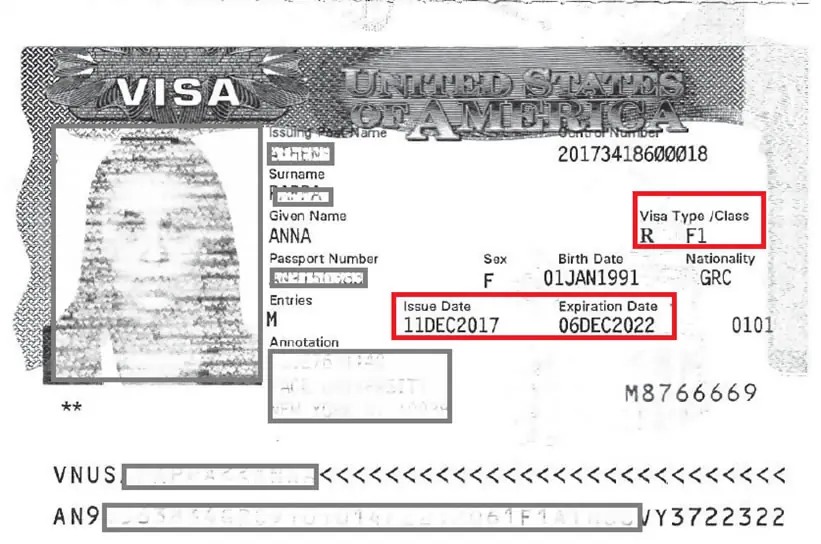
    • Visa: A visa is a stamp placed in your passport that permits you to enter the United States. The F-1 visa allows you to enter the U.S. as a student, but it does not determine how long you can stay. It only grants permission for entry. Having a valid visa does not guarantee 100% entry into the U.S.; the final decision is made by a CBP (Customs and Border Protection) officer upon your arrival.
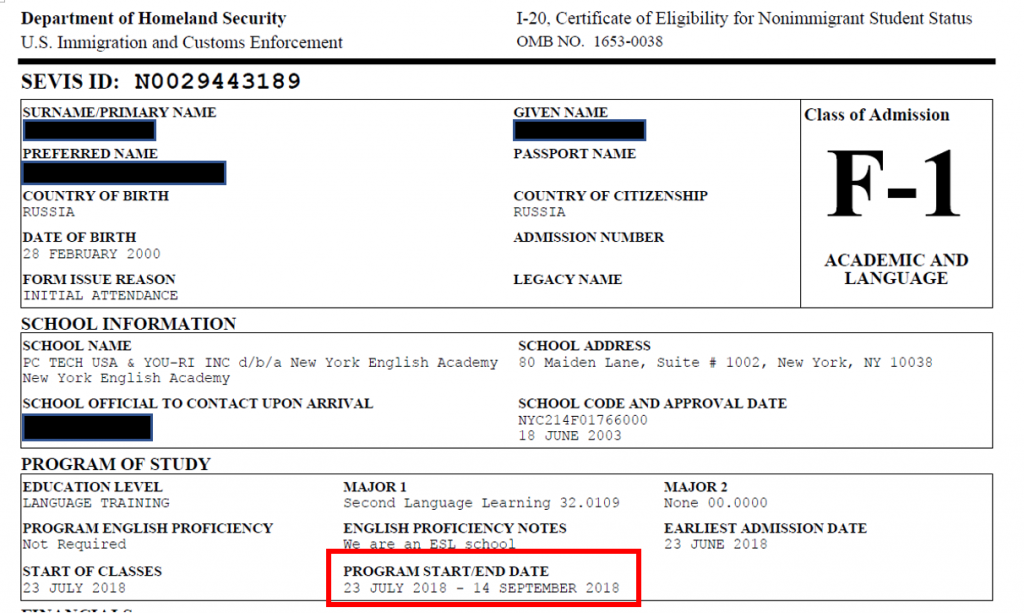
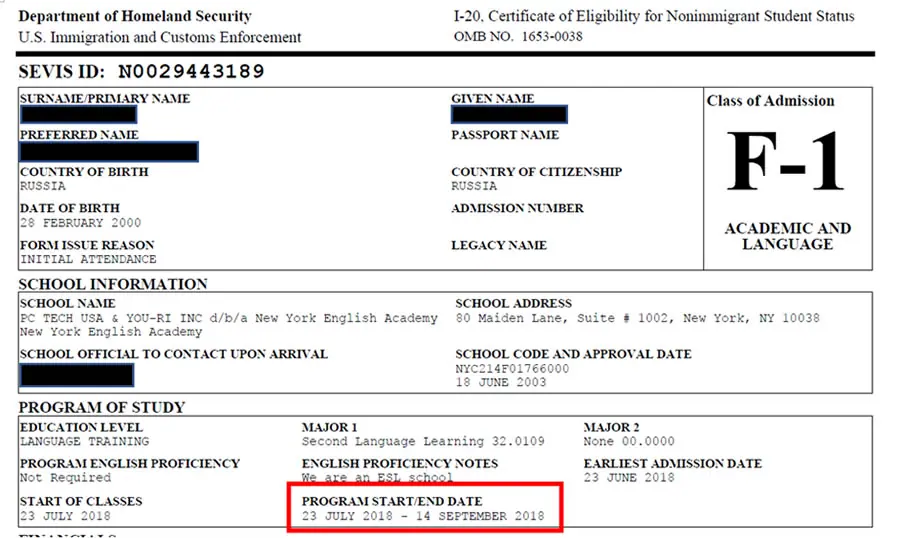
    • I-20: The I-20 is a document issued by your school that certifies your enrollment and eligibility to study in the U.S. It includes the start and end dates of your program, and it dictates the period during which you can legally remain in the country.

    These two documents serve different purposes, and their validity periods are not necessarily the same.
    The visa allows entry into the U.S., while the I-20 allows you to remain in the U.S. during your studies.

    Differences Between the I-20 and F-1 Visa Validity

    • I-20: The I-20, issued by your school, must remain valid throughout your enrollment. The first page of your I-20 indicates the authorized dates for your studies, and this determines your legal stay in the U.S.
    • F-1 Visa: The F-1 visa stamp in your passport indicates the period during which you are permitted to enter the U.S. as a student. In some cases, the F-1 visa may have a longer validity period than your I-20. For example, your F-1 visa could be valid for five years, while your I-20 covers a six-month program.

    Important:

    Even if your F-1 visa is valid, if your I-20 expires and no action is taken, your stay in the U.S. becomes illegal.
    Please talk to your school DSO.

    What is a DSO?

    A DSO (Designated School Official) is a critical figure at U.S. educational institutions, serving as the official liaison between the school, international students on F-1 visas, and the U.S. government.
    Appointed by the school and approved by the Department of Homeland Security (DHS), the DSO’s main responsibility is to ensure that both the school and its international students comply with all U.S. immigration regulations.

    Reasons Why Your I-20 Might Expire

    There are several reasons why your I-20 might expire, and it’s essential to be aware of these situations:

    • Completion of the Program

      The I-20 is valid for the duration of your program, as listed on the form. When your program ends, so does your I-20.
      After your program is completed, you will be granted a 60-day grace period during which you must transfer, enroll in another program, or leave the U.S.

    • Loss of Full-Time Enrollment Status

      If you fail to enroll in the required number of credits or do not maintain full-time status, you may lose your F-1 status.
      In this case, your school may terminate your I-20.

    • Withdrawal or Leave of Absence

      If you take a leave of absence or withdraw from your program, your I-20 may become invalid.
      These actions can lead to the loss of your legal stay in the U.S., so it’s crucial to consult with your DSO (Designated School Official) beforehand.

    • Failure to Pay Tuition

      Failure to pay tuition or prolonged unpaid tuition may result in your school terminating your I-20.
      Paying tuition is a requirement to maintain I-20 validity.

    • Unauthorized Employment

      F-1 visa holders are only permitted to work under specific conditions.
      Engaging in unauthorized employment, either off-campus or in a prohibited capacity, can result in the termination of your I-20, visa cancellation, and possible deportation.

    • Poor Attendance

      Many schools require students to maintain a certain attendance rate.
      If you fail to meet these requirements, your I-20 may be terminated.
      It’s critical to attend classes regularly and adhere to your school’s attendance policies.

    • Delay in Extending Your Program

      If you need to extend your program, you must apply for an I-20 extension before your current program ends.
      Failing to do so may result in the expiration of your I-20 and an illegal stay.

    What to Do When Your I-20 Expires

    If your I-20 is nearing its expiration date, you have three options:

    • Transfer to another school and obtain a valid I-20: You must obtain a new I-20 from the new institution.
    • Leave the U.S.: After completing your program, you are allowed a 60-day grace period during which you must depart the U.S.
    • Extend your program and obtain a new I-20 from your current school: If eligible, you may apply to extend your I-20 with your current school.

    If you successfully complete your program, you are allowed a 60-day grace period to take one of the above actions.
    This grace period allows you to legally remain in the U.S. during this time.

    Note:

    If you withdraw from your program or are dismissed, the grace period is reduced to 15 days.
    Staying beyond this period without taking appropriate action may result in an illegal stay, which can negatively impact your future ability to stay in or re-enter the U.S.

    What Happens if Your Visa Expires During Your Stay?

    As long as your I-20 remains valid, it is legal to stay in the U.S. even if your F-1 visa expires while you are here.
    However, if you leave the U.S. and wish to re-enter, you must have a valid visa.
    Therefore, you will need to renew your visa before re-entering the U.S.

    Important:

    Visa extensions cannot be done from within the U.S. You must leave the country and typically apply for a visa renewal at the U.S. embassy in your home country.

    What is Most Important for F-1 Visa Students?

    The most important thing for F-1 visa holders is to always maintain a valid I-20.
    As long as your I-20 remains valid, you can legally stay in the U.S. However, it’s crucial to take action promptly if your I-20 is nearing expiration.
    Always ensure that your stay and studies remain in compliance with U.S. immigration regulations.

    Additionally, keep up to date with F-1 visa regulations by checking the USCIS website and other official resources.

  5. The Electronic System for Travel Authorization (ESTA) is a program that allows citizens of Visa Waiver Program (VWP) countries to travel to the United States without a visa.
    This program is designed for short-term travel, such as tourism or business, but it is important to note that ESTA is not a substitute for a student visa.
    Below is an overview of ESTA and important points to keep in mind when applying.

    Overview of ESTA

    • Eligibility: Citizens of countries participating in the Visa Waiver Program (VWP) can apply for ESTA. The following countries are eligible:
      Andorra, Australia, Austria, Belgium, Brunei, Chile, Czech Republic, Denmark, Estonia, Finland, France, Germany, Greece, Hungary, Iceland, Ireland, Italy, Japan, Latvia, Liechtenstein, Lithuania, Luxembourg, Malta, Monaco, Netherlands, New Zealand, Norway, Portugal, San Marino, Singapore, Slovakia, Slovenia, South Korea, Spain, Sweden, Switzerland, Taiwan*, United Kingdom**
    • Purpose: ESTA can be used for tourism, business, medical purposes, or short-term study (fewer than 18 hours of classes per week). For long-term studies or full-time enrollment, a student visa is required.
    • Duration: ESTA allows you to stay in the United States for a maximum of 90 days. Staying beyond this limit is considered illegal, so make sure to depart the U.S. before your stay exceeds 90 days.
    • Important Note: ESTA is not a visa. You cannot change your status to another visa (such as an F-1 student visa) while staying in the U.S. on ESTA. If you need to switch to another visa type, you must leave the country and apply for the visa from abroad.
    • How to Apply: You can apply for ESTA online through the official U.S. Embassy website. The application fee is $14, payable by credit card.

    Important Points When Applying for ESTA

    • Apply Early: It is recommended to apply for ESTA at least two weeks before your trip, even though it can be done up to 72 hours before boarding your flight.
    • Validity: ESTA is valid for two years from the date of application, or until your passport expires, whichever comes first.
    • No Guaranteed Entry: Having an approved ESTA does not guarantee entry to the U.S. The final decision is made by U.S. immigration officials upon your arrival.
    • Beware of Overstaying: The maximum stay on ESTA is 90 days. Overstaying this limit is illegal, and you may be denied entry on future visits.
    • Answer Questions Carefully: The ESTA application process can be completed on a smartphone, but it is recommended to use a computer to ensure accurate answers to all important questions.

    Warnings for ESTA Users

    If you engage in illegal activities during your stay in the U.S., you may face future entry bans.
    Pay special attention to the following:

    • Overstaying: The maximum stay on ESTA is 90 days. Staying beyond this limit will result in illegal status and could lead to a denial of entry on future visits.
    • Illegal Employment: Working while on ESTA is prohibited. If caught working illegally, you could be banned from entering the U.S. again.
    • Other Illegal Activities: Fraud, theft, drunk driving, and illegal sexual activities are all considered serious offenses and can result in restrictions on future travel to the U.S.

    Enjoying a Safe Stay in the U.S. with ESTA

    ESTA is a convenient option for short-term travel to the U.S. for tourism or business, but there are several important rules and restrictions to keep in mind.
    By following these guidelines, you can ensure a safe and enjoyable stay in the United States.

  6. Today’s blog is a serious topic. It’s about something that I-20 holders want to know. This information has been personally exchanged with the person responsible for the SEVIS.

    Since last year, the SEVIS Field Associate (responsible for our school) has regularly come to visit the campus several times. They come to share the latest rules and visa information regarding the SEVIS, and to check that our school isn’t unusual at the same time.

    Aside from that, the one question that we are often asked by students is:

    “Will I be able to get the 60 days Grace Period?”

    The Grace Period is a sixty-day legal stay within the country following the completion of your program. During this time, a student must either transfer to another school, or leave the United States.

    The one thing that students on an F1 visa tend to get incorrect is that they will automatically be entitled to the 60 days Grace Period if they hold a valid I-20. This is wrong.

    Not everyone is entitled to the sixty-day legal stay. To receive the Grace Period, a student must meet the requirements outlined below.

    Properly complete their program →  this means they complete their program without failing, and while meeting the appropriate attendance rates.

    For example, a student has enrolled in a twelve-week program. Imagine they have now transferred to another school in the middle of the program. This transfer is possible, but it means they haven’t completed their program in this case (since they have transferred) and are not entitled to the 60 days Grace Period.

    In this particular case, the student has a 15-day legal stay within the country.  During this time, they must either leave the United States, or complete the transfer process to the new school and begin their next program from the earliest possible start date.

    If a student’s attendance is insufficient, and their I-20 is terminated by the school, they must leave the United States immediately.

    As for transfers, the SEVIS advises that it doesn’t mean “It would be good to complete the transfer process within the 60 days, and start the program at your next school”, but rather, “If you want to transfer during the Grace Period, you should finish the application process promptly and start your new program from the earliest possible start date.”

    It is vital for students staying in the country on an F1 visa to take personal responsibility for maintaining their status. (Especially regarding attendance)

    Students who come to America on an ETSA are able to stay for 90 days. Staying any longer than this will be an illegal stay and this will remain on their record.

    It is highly likely that applications for visas from people with a record of illegal stays will be rejected. Please take plenty of care.

  7. Transfers between language schools are popular within America. As mentioned previously in this blog, it is possible for the transfer process to be completed by the student themselves.

    Transfer Process

    1. Before the conclusion of your program, decide whether to extend the program at your current school or transfer to another
    2. If you decide to transfer, choose the school you will transfer to
    3. Proceed with the enrollment process of the school you will transfer to (fill in application forms, make payments etc; please follow the school’s procedure)
    4. Submit required documents to your current school
    5. Your current school moves your SEVIS record to your next school

    This isn’t a difficult process, but some troubles have occurred from time to time.

    A student has forgotten to submit the documents, and their status changed to ‘Complete’.

    The documents required to move your SEVIS record to the next school are the ‘Transfer Form’ and the ‘Acceptance Letter’ for the school you are transferring to.

    The issues that occurred in a certain case are related to this.

    A student who had completed their program submitted a ‘transfer form’. The staff filled out all the necessary information and handed the form back to the student. Despite being urged to submit the acceptance letter prior to the final day, it was not submitted. More than sixty days passed following the end of the student’s program, and their status changed to ‘Complete’.

    As previously mentioned in this blog, in the sixty days following the end of your program date (in the case of our school, the last day of your I-20 validity is the end date of your program) you will enter a Grace Period.  Students must either transfer schools during this period or leave the United States.

    The SEVIS status will automatically switch from ‘Active’ to ‘Complete’ on the 61st day. Once a status has become ‘Complete’, the school can do nothing more. You need to leave the US immediately.

    Why is the transfer process incomplete without an ‘Acceptance Letter’?

    Most schools mention the following warning on their ‘transfer forms’:

    “Please do not release the student’s SEVIS record to us until our school DSO has confirmed acceptance of the student via a written Letter of Acceptance. This transfer Verification form is not a confirmation of acceptance.”

    According to this warning, your current school cannot send your record to them unless both your ‘acceptance letter’ and ‘transfer form’ are complete.

    Even if you complete your enrollment form and payment of fees, and the transfer process has been completed at the school you’re transferring into, whether or not your record is transferred depends on whether or not your documentation has been submitted properly.

    At each school’s discretion, if a student’s SEVIS record has not been transferred despite completing the transfer process, the school may be able to contact the previous school and check the issue. However, not all schools will go that far.

    NYEA takes a lot of admissions from other schools. After completing the enrollment process with us, we issue an ‘acceptance letter’ and we always ensure to send the ‘transfer form’ and ‘acceptance letter’ to the school the student is transferring from. We will contact the previous school in cases where the record has not been sent to us.

    The transfer process is not difficult, but it’s a good idea to confirm the steps with the staff at your current or future school.


  8. As long as your student visa remains valid (even if your I-20 has expired) your stay in America may be mistakenly considered a legal stay.

    The I-20 form is attached to the F1 visa. Your I-20 must be valid for the duration of your study. The validity period is stated on the first page of the I-20 form.

    The validity period of your visa is stamped on the visa page.

    These two periods of validity are not necessarily limited to one another.

    Let’s consider an example where the student has enrolled in a six-month program. The I-20 document states a validity period of 6 months; however, the F1 visa has been approved for a period of 5 years.

    *There may be some cases where schools allow a validity period of one year or more even for a six-month enrolment. Each school’s policy differs on this*

    The most important thing for students holding an F1 visa is to ensure that they also have a valid I-20. If the validity period expires on their I-20, they must do one of the following:

    • Transfer into a different school within 60 days from your current program ending date
    • Leave the United States within 60 days from your current program ending date
    • Have the I-20 renewed at the current school (this may or may not be possible)

    The abovementioned 60 days are referred to as a “grace period”. If a student completes a program at their enrolled school, they will receive a legal-stay period of 60 days.

    In cases students are terminated by the school with some reasons, then they do not receive this 60-day period and they may be unable to transfer to another school.

    If, during the 60-day grace period, a student does not go through the procedure to transfer schools and remains within the US, their stay will become an illegal one.

    In cases where a student’s program has finished but they wish to continue their studies in the US, we ask that they extend their program and acquire an extension of their I-20 from their school. Students should always ensure that they personally retain their currently valid I-20.

    The extension procedure at the New York English Academy is as follows:

    1. Complete the application form for the next program
    2. Prepare the certificate of bank balance
    3. Pay the fees for the next program

    Even if your visa expires while you are residing in the United States, as long as you hold a valid I-20 your stay will be a legal one. It will not become an illegal stay.

    However, if you temporarily leave the country and re-enter, you will require a valid visa and will need to go through the visa extension procedures.

    It is not possible for students to extend their visa within America, so they will be required to do so from outside the country or from their home country. Please contact your individual schools for the documents necessary for a visa extension application. The New York English Academy will assist you with any documents required to avoid any issues with your visa extension, including your transcripts and a support letter from the school.


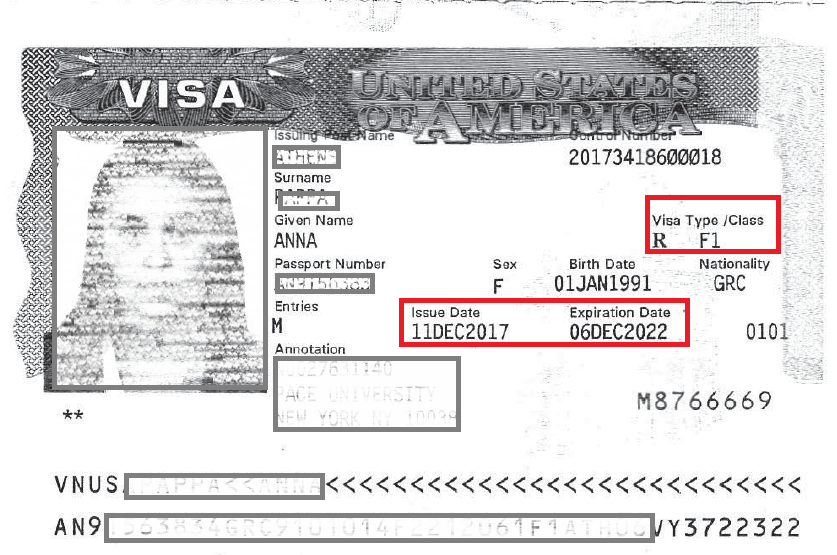
  9. Entry into other countries basically requires both a visa and a passport.

    The first thing that is essential for passage into a foreign country is a passport. Without a passport, you will be unable to leave Japan. However, even though you’re able to leave Japan with just a passport, you may not be able to enter other countries. A “visa” is a document which allows entry to specific foreign countries, like an entry permit. Once a visa is issued, it is attached to your passport.

    Visas are split into many different types. We will be explaining the different kinds of American visas. The two main categories are “Non-immigrant Visas” and “Immigrant Visas”.

    A Non-immigrant Visa is a visa that allows you to stay in the United States for a specified period of time to accomplish a specified purpose. This is applicable for those who are tourists, students, businesspeople or special workers etc.

    An Immigrant Visa is a permit to allow you to reside in the United States on a Green Card or after applying to be an American citizen.

    Usually, those studying abroad will be under the “Non-Immigrant Visa” category. Non-Immigrant Visas are divided into various types according to the purpose of the traveller.

    Commercial/Tourist Visa (B1/B2 Visa): Short-term entry visas for business, travel or medical treatment purposes.

    Employment Visa (H1, L, O, P, Q Visa etc): Visas that permit legal employment. These are visas for working within the United States. Depending on the type of work, these visas are split into different types; e.g. special skilled laborers, internal transfers, artists, entertainers, athletes etc.

    Student Visa (F1/M1 Visa): Visas for studying abroad.

    Exchange Visitor Visa (J Visa): A visa for those participating in exchange programs such as training programs and internships etc.

    Transit/Cruise Visa (C/D Visa): Visas for the staff and crew of planes and ships entering and landing in America.

    Religious Activist Visa (R Visa): A visa for those undergoing religious activities.

    Employee Visa (B, A, G Visa etc): Visas for those travelling with an employer; these are divided according to the visa status of the employer. This applies to people such as butlers, drivers, housekeepers, assistants, gardeners, diplomats and government officials etc.

    Press Visa (I Visa): A visa for news media (who are based in foreign countries) to temporarily stay in the United States.

    Treaty Trader/Investor Visa (E Visa): A visa for residents of countries that have treaties and investments with America.

    Spouse Visa (K Visa): A visa for those who are engaged to a U.S. citizen and wish to gain permanent residency in America.

    You will need a visa that matches the purpose of your stay in the United States.

    Generally, to study abroad, apply for a Student Visa (F1 or M1 Visa).

    All visas have specific accompanied documents.

    For example, the J Visa has the DS-2019 document, and the H Visa has the I-129 document. In the case of the student visas, this document is called the I-20 form.

    Both the F1 and the M1 are Student Visas.

    For general university and language school studies, you’ll need the F1 Visa. For specific professional studies or training, computing, IT classes etc, you’ll need the M1 Visa. Students who attend the New York English Academy will have an F1 Visa.

    When entering the United States, you must go through Immigration. (Specific to the JFK airport)

    The procedure for entering the United States is as follows:

    1. Arrival of the plane
    2. Immigration
    3. Baggage collection
    4. Customs
    5. Airport arrival lobby

    Go through Immigration once your plane has landed. This will be split up into two lanes, one for American residents and one for foreign residents. Line up in the lane for Non-US Citizens.

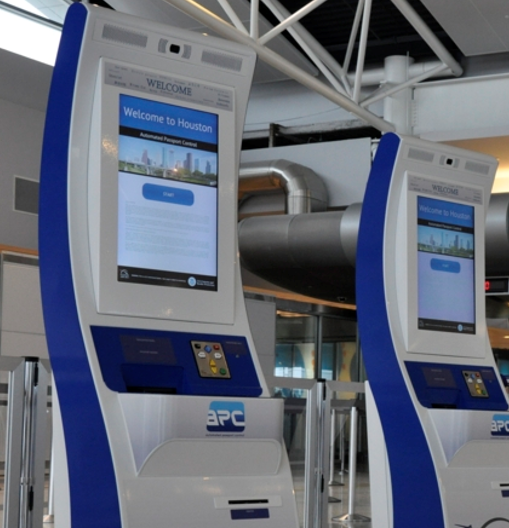
    Immigration at the JFK Airport in New York City has kiosks. (Some other airports may not have kiosks)

    The John F. Kennedy Airport is a large airport which serves as the gateway to the East Coast of the United States, with many international visitors. The “APC KIOSK”, or Automatic Passport Control Kiosk, has been implemented to cut down on immigration.

    <Immigrants who can use the kiosks> Those who can use the kiosks do not need a customs declaration form.

    • People who have an ESTA and have entered the U.S. after 2008
    • U.S. citizens
    • Permanent residents of the U.S.
    • Canadian citizens

    <Immigrants who cannot use the kiosks>

    • People entering for the first time with an ESTA
    • People who have entered with an ESTA after 2008 but have renewed their passport
    • People on a student or work visa
    • People who have been directed by personnel to use the immigration desk

    [Using the Kiosks]

    1. Choose your language
    2. Scan your passport on the screen
    3. Answer the U.S. Customs questions
    4. Answer ‘yes or no’ for ESTA registration
    5. Fingerprint scan
    6. Photo taken
    7. Confirm travel companions
    8. Confirm arrival flight information

    Once everything has been completed, a receipt will be printed, and you will need to line up for Immigration. This is a simple lane just for showing your documents, and it means there are no issues with your entry. However, if there is a cross on the printed receipt, you will need to proceed to the same in-person immigration examination as other visa holders.

    Sometimes this cross is displayed if your photo or fingerprints are not taken correctly.

    Immigration Procedures

    For immigration, you will need a passport containing the correct visa, and the accompanying documents for that specific visa. (In the case of a Student Visa, the I-20 form). Submit these to the immigration officer.

    Having a visa does not necessarily mean you can enter the country. The immigration officer will allow your entry by checking your visa type, your purpose for visiting, and whether or not your documents have expired. At this time, the immigration officer may ask you some questions.

    • Purpose of visit
    • How much money you have
    • How long you plan to stay
    • Where you will be staying

    If nothing is checked, the immigration procedure is over. If there are any issues or some of your documents are missing, more checks will be necessary, and you will be led into a separate room. This procedure will take a considerable amount of time, so please ensure your documents are completed prior to immigration.

    Please refer to the following video for an explanation.

    Please note that circumstances and procedures will differ with each airport.

    Once you have gone through Immigration, collect your luggage and proceed to your destination. The New York English Academy offers “First-Day Immigration Support” as an option. There is also a pick-up service to take you to your accommodation.

    *First-Day Immigration Support: We will pick you up from the airport and take you to your accommodation. Once you have dropped off your belongings, we will show you around the facilities and areas you will be using during your time here. This is the recommended option for those coming to New York for the first time.